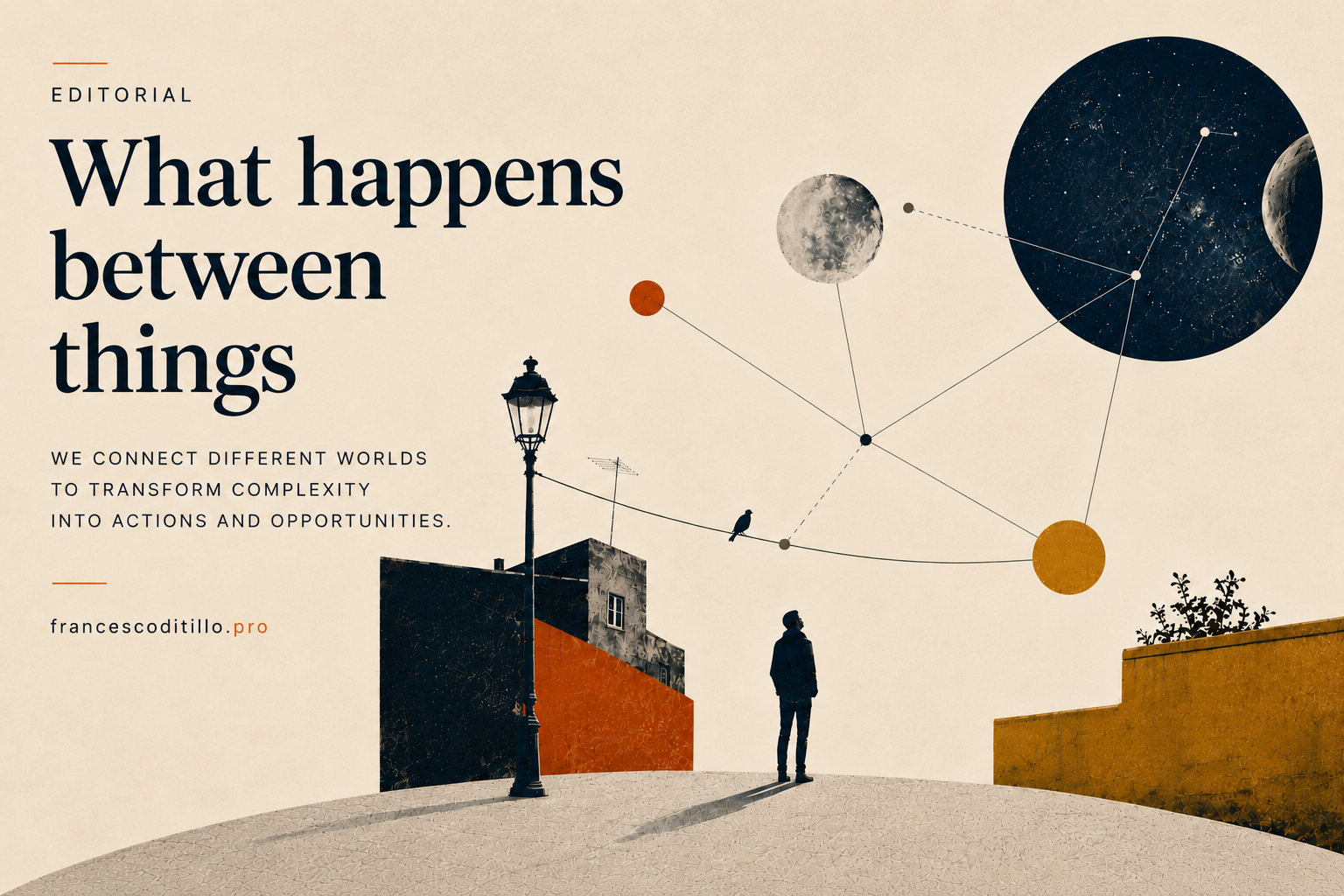
I’ve always moved between different worlds, and I still do. Communication, marketing, art, sustainability, business, institutions, associations, communities. The contexts change, the countries, the people, the languages and the skills that come into play.
And perhaps this constant movement is exactly what keeps me interested: discovering what happens when seemingly distant worlds come into contact.
From a distance, they might look like separate chapters, different issues altogether.
For a while, I thought so too. Although, in reality, I was always looking for what held them together.
Maybe because I find it hard to believe in boundaries that are too clear-cut. The one between communication and relationships, for example. Between sustainability and productivity. Between culture and business. Between strategy and creativity. Between an event and the data it leaves behind. Between what happens inside an organisation and what is happening on the street just outside.
Even between personal and professional life — however much more convenient that separation would sometimes be.
Over time, I realised this natural inclination wasn’t simply curiosity. It had become a way of seeing things, and a way of working.
Today, I call it Systemic Advantage.
It doesn’t mean knowing everything about everything. It doesn’t mean trying to be everything at once. And it doesn’t mean avoiding specific expertise.
It means, rather, trying to see the connections before the individual parts. Understanding the system well enough to decide where to intervene with precision.
It means, quite literally, building a systemic advantage.
The more dots you can join, the more relationships you can recognise, the more seemingly distant things you can bring into conversation, the wider your perspective becomes. But the advantage doesn’t come from connecting everything to everything else. It comes from recognising the connections that matter — the ones capable of giving you direction. And once the direction becomes clearer, action can become more precise. Surgical, even.
Because an organisation is more than the products and services it offers. A brand is more than its communication. A cultural project is more than culture. An environmental problem is more than ecology. And a community is not simply the sum of the people who live in it.
Every element affects the others. Every element is interdependent to some degree.
It’s a way of seeing things that owes a great deal to my studies and experience with permaculture and, more broadly, systems thinking: observing before intervening, recognising relationships, using the resources already available, avoiding waste, looking for more than one function in the same action.
This is where a formula that has guided the way I work for years comes from:
For every action, two solutions.
For every problem, two opportunities.
This isn’t optimism printed on a motivational mug.
It’s a method.
An everyday action, when it matters, should be approachable in at least two different ways. Ideally simple, light, mindful of resources and quick to test.
Having an alternative forces us to compare solutions, understand which one actually works better, and prevents us from falling in love too quickly with the first idea — something of a popular sport across many industries.
A problem, however, requires a different attitude.
If it’s genuinely a problem, fixing the symptom probably isn’t enough. We need to understand where it comes from, which relationships it involves and what it is calling into question.
And then try to go one step further: turn it into an opportunity.
Not one, but two.
Not to deny the difficulty. Quite the opposite: to make use of what that difficulty forces us to see.
A problem, if we approach it well, can lead us to change a process, discover a missing relationship, remove something unnecessary, create a service, rethink a strategy, or meet someone who had previously remained outside our horizon.
In other words, the question isn’t only how to get out of a problem. It’s also what that problem allows us to see, change or build that we couldn’t see before.
Sometimes the best solution is to do something new.
Other times, it is simply to do less, but do it better.
Widening the View to Decide Where to Act
Over the years, I’ve become convinced that being a contemporary professional doesn’t necessarily mean becoming increasingly specialised.
Specialists are essential. I definitely want my dentist to be highly specialised at what they do.
But the reality in which that dentist, a company, an institution, an association — or any of us — has to make decisions every day is becoming less and less vertical.
Economics, technology, the environment, culture, behaviour, communication, politics, places, relationships and individual desires are constantly intersecting.
We can divide everything into departments, disciplines, job titles and folders on our computers.
Reality will keep crossing those boundaries anyway.
This is where Systemic Advantage begins: in the ability to move across different horizons and try to bring them back together into a view broad enough to find a direction.
Not necessarily a definitive view. But certainly one clear enough to allow us to act without too much uncertainty.
That’s the part that interests me most.
Because systems thinking, if it remains just thinking, risks becoming a magnificent diagram hanging on a wall.
What I’m looking for instead is the point where strategy and practice meet: where a connection becomes a decision, a decision becomes an action, and that action produces a result we can observe, measure and, when necessary, adjust.
And So, the Insights.
These Insights come directly from this way of thinking.
They are not meant to be lessons.
Nor another place explaining to the world the five things it absolutely needs to know by Friday.
They are moments for reflection, action and connection.
They start from different worlds because that is what the world is like.
Marketing and sustainability. Technology and relationships. Culture and organisations. Artificial intelligence and very human intelligence. Cities, businesses, the environment, politics, communication, work, art, behaviour, communities.
Sometimes they’ll start with a piece of data. Other times with research, a news story, a project, a conversation, a mistake, or something that simply made me think:
“Does this actually seem normal to you?”
I won’t necessarily be looking for a definitive answer.
I’ll be looking for connections.
Because even those who are deeply specialised live and work inside complex systems. Understanding even one more piece of those systems can help us see opportunities that, if we only look straight ahead, would remain out of sight.
The Insights are also my way of continuing to explore.
Of connecting what I know with what I don’t yet know.
Of taking a position whenever I believe it matters, changing my mind when there are good reasons to, and leaving some questions open when closing them would simply be a shortcut.
And, above all, of trying to turn reflection into something useful.
For someone working in a company. Someone building a project. Someone working within an institution or a community.
And, quite simply, for anyone trying to understand a little better what is happening around us.
Because, in the end, the point isn’t to know everything.
It’s to see far enough to understand where the next step should be.
And perhaps discover that it’s a step we can take together.