The weekend — at least in its modern form of two consecutive days off — is turning 100.
In 1926, Henry Ford introduced a five-day, 40-hour working week in his factories. But the struggle to reclaim time from work had begun much earlier. In 1919, the International Labour Organization’s first Convention established the eight-hour day and 48-hour week as an international benchmark. It wasn’t simply a gift from industry. It followed decades of pressure from the labour movement.
A century later, we are discussing working time all over again: shorter weeks, hybrid work, flexibility, the right to disconnect.
I find the conversation interesting, but perhaps for a slightly different reason.
We keep talking about how much we work. We talk much less about when our free time actually happens.
Those are not quite the same thing.
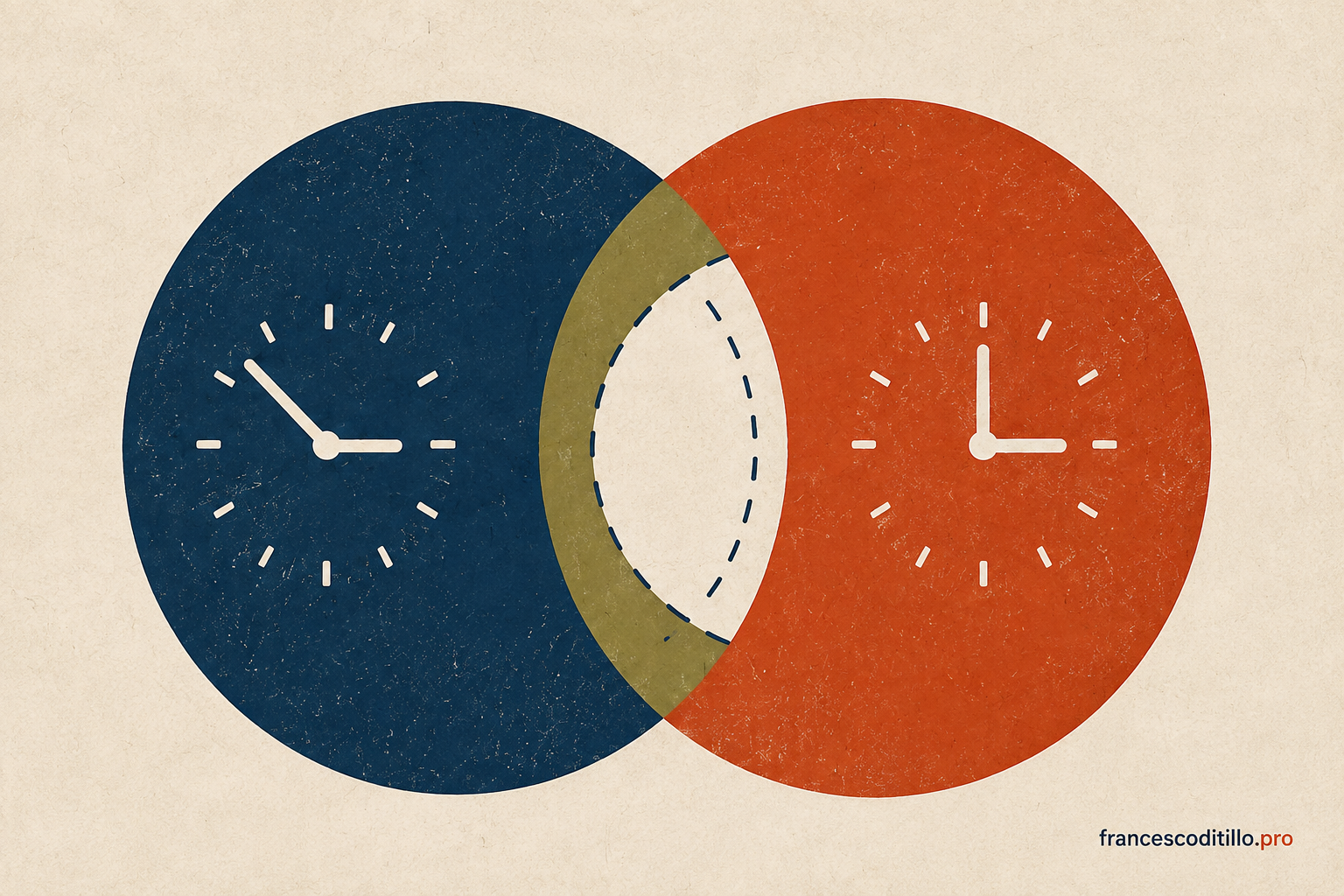
I can have more free time. But if my day off is Tuesday, my wife’s is Friday, my friends are free on Saturday and my child’s school follows yet another timetable, we may have gained individual time without necessarily gaining time together.
Perhaps one of the great ideas behind the weekend was not simply giving people two days away from work. It was synchronising them.
For decades, that synchronisation produced things that rarely appear in productivity spreadsheets: lunches, football matches, day trips, associations, volunteering, celebrations, public spaces, families, friendships. Even the simple possibility of knowing that, at roughly the same time, other people might be available too.
Of course, this was never universal. Hospitals, restaurants, transport, retail, tourism, care work and many other sectors have never collectively stopped on Friday evening. Romanticising the traditional weekend as some golden age would therefore miss the point.
The point is elsewhere.
Flexibility can help us fit work around life. That is an important achievement. But pushed far enough, it can create a paradox: the more each of us owns our individual time, the harder it may become to find time that belongs to all of us.
And that is where this stops being only an organisational question. It becomes a social one.
Shared time is a kind of invisible infrastructure. Like a square or a public park, it only really works when other people can inhabit it with us.
Perhaps the next innovation in work, then, is not simply about reducing working hours or making them more flexible. It may also be about designing organisations that protect some common time — within teams, families and communities.
That does not mean sending everyone back to the same timetable, the same office, five days a week. That would be a simple answer to a question that isn’t simple.
It does mean adding another question when we design work: How much time are we freeing?
And immediately afterwards: How much of that time will we actually be able to share?
It took us more than a century to win the right to have time of our own.
Perhaps the next achievement is finding a little more of it together.