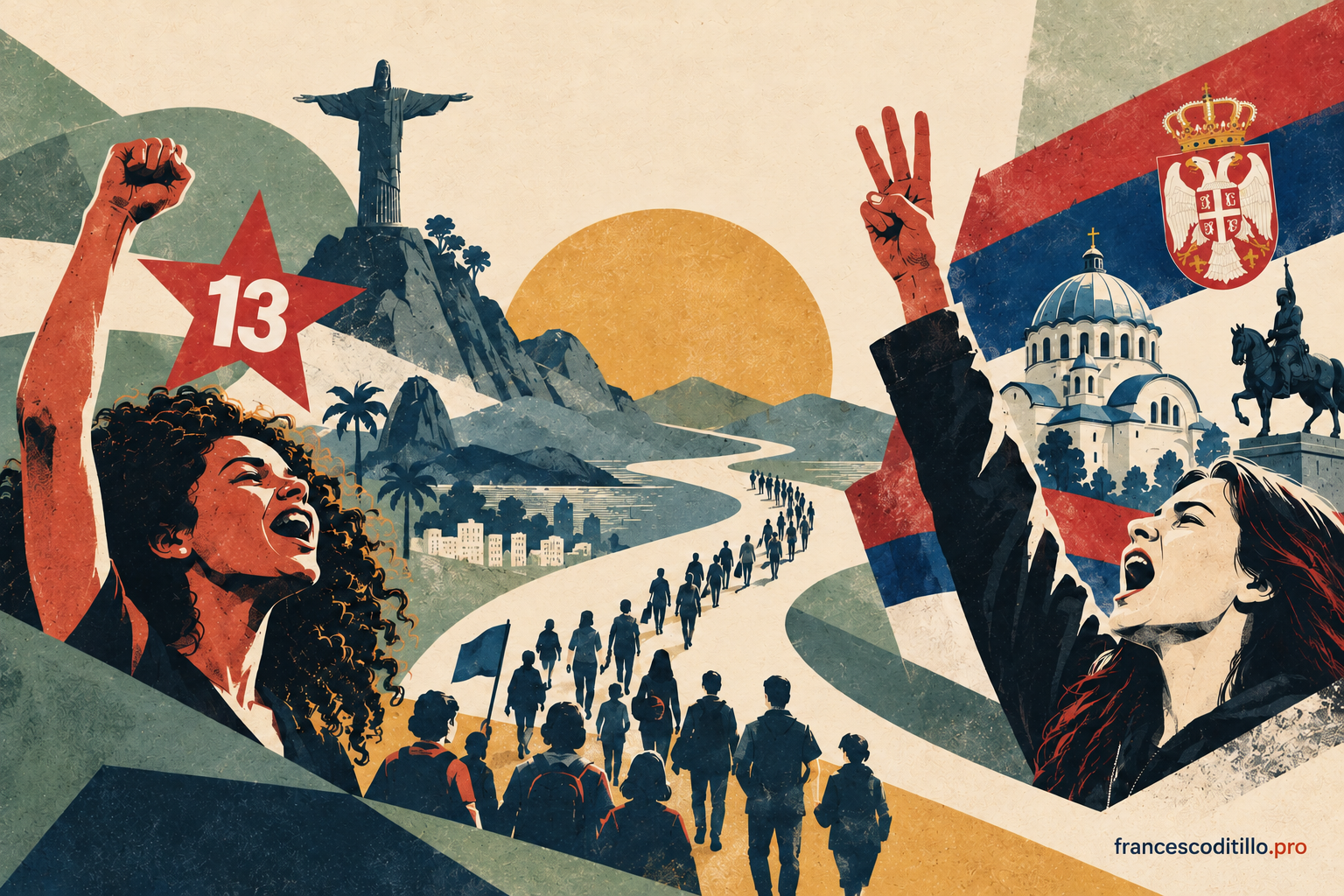
In Brazil, Luiz Inácio Lula da Silva won reelection with 51.79% of the valid vote, overcoming his first-round deficit. In Serbia, the Student List won 52.65% according to preliminary results, bringing an extraordinary student-led movement into the center of national political power.
Two countries. Two different histories. An eighty-year-old president who has spent much of his life in politics, and a movement that grew out of universities, streets, public squares, and communities.
Yet when I look at these events together, I cannot help seeing the possibility of something much bigger.
What if we are approaching a generational and social turning point?
Not simply a change of government. Not merely one political side defeating another. But a sign that people, in different places and through different methods, are beginning to challenge the idea that their future must be decided by a few, while everyone else is expected to adapt.
I do not know whether we are witnessing a historic turning point.
But I believe it would be a serious mistake to overlook what these events might be telling us.
Democracy is not dead. Perhaps we have forgotten what it means. For years, the word democracy has appeared everywhere.
It has been invoked to justify policies, interventions, wars, restrictions, economic interests, and political confrontations. Used so often, and in such contradictory ways, that it sometimes seems to have lost its meaning. But democracy is not a word that belongs to a government, a political party, or a particular cultural tradition.
And democracy cannot be reduced to holding elections every few years.
It exists when people can organize, speak freely, disagree, participate, and influence collective decisions. When institutions are accountable to citizens. When political power can be challenged and replaced without sacrificing fundamental rights.
In Serbia, the student movement's electoral success carries particular significance against a background of concerns raised by independent observers about political pressure, unequal conditions, and the use of institutional resources during campaigning.
In Brazil, Lula's victory followed an intensely polarized contest against Flávio Bolsonaro, who rejected the result announced by the electoral authority.
The two situations are not identical, and we should resist the temptation to treat them as interchangeable.
But they raise a common question.
What does it take for democracy to remain more than a promise?
For me, defending democracy means more than opposing authoritarianism. It also means creating new ways to share responsibility, challenge concentrated power, and make institutions genuinely responsive to people.
Democracy is not something we inherit once and preserve forever.
It is something we must continually practice.
Have we become too accustomed to being governed through fear? We live in a world where uncertainty seems to have become a permanent condition.
Wars. Military spending. Economic insecurity. Inequality. Housing costs. Climate disruption. Precarious work.
These are real problems, with real consequences for people's lives.
Yet so much political communication seems designed primarily to turn these problems into fear.
Fear of losing something. Fear of outsiders. Fear of change. Fear of being left unprotected.
Fear can be an extremely powerful communication tool. It attracts attention, simplifies conflicts, and creates political identities through opposition. But what kind of future can a society build if people are constantly asked to choose only what they are afraid of?
When did we stop expecting politics to help us imagine something better?
This, to me, is one of the most interesting questions raised by the two elections.
Not because we can prove that Brazilian and Serbian voters were motivated by hope rather than fear. Political choices are far more complex than that.
But because both experiences demonstrate the ability to organize participation around the possibility of changing an existing situation.
And today, even the belief that change is possible can be significant.
Lula is eighty. Ideas do not have an age. There is something fascinating about the Brazilian result.
Lula is not a new political figure. His career stretches across decades of social, economic, and cultural change.
Yet his campaign had to rethink its communication, intensify mobilization, and strengthen connections to reverse the first-round result.
That does not make him a young leader. Nor does it prove that younger voters were primarily responsible for his victory.
But perhaps generational change is not simply about replacing older leaders with younger ones.
Perhaps it is also about recognizing that the language of participation has changed.
People do not necessarily want to be treated as passive recipients of messages designed somewhere else.
They want to recognize themselves in the conversations, decisions, and projects that shape their lives.
Lula's campaign made extensive use of digital networks, public mobilization, and coordinated online communication. Those methods deserve critical examination, including their potential to intensify polarization.
Still, the broader lesson is worth considering.
Experience and authority are not enough if they cannot connect with the expectations of the present.
And that is not just a political problem. How many businesses, institutions, and organizations still assume that yesterday's authority is sufficient to earn tomorrow's trust?
When algorithms influence who gets heard Brazil also exposed a deeper contradiction in contemporary communication.
During the election campaign, reports based on internal Meta communications described restrictions that negatively affected Lula's accounts on Instagram, alongside algorithmic recommendations involving Flávio Bolsonaro's profile and WhatsApp channel.
Brazil's electoral court intervened to require equal treatment of both campaigns.
Meta acknowledged technical incidents but denied deliberately favoring either candidate. The court did not establish intentional political manipulation.
That distinction matters.
But the underlying question remains.
How can democratic participation be fully meaningful when the visibility of political ideas depends on private systems that citizens cannot easily understand, examine, or control?
Digital platforms have opened extraordinary opportunities for communication and collective organization.
They have also concentrated enormous power over the distribution of information.
The same infrastructure that allows communities to connect can influence which voices become visible and which remain difficult to find.
This is not only a Brazilian issue.
It is a question about democracy, technological power, transparency, and accountability.
And it is becoming impossible to separate these subjects.
Serbia: when a protest becomes an organization Serbia tells a very different story.
The movement emerged after the collapse of a railway station canopy in Novi Sad in November 2024, a tragedy that killed sixteen people and triggered demands for accountability.
What followed was not simply a series of demonstrations. Students organized assemblies, marches, university occupations, local meetings, and initiatives reaching communities far beyond major urban centers.
Over time, protest became a network.
The network became an organization.
And the organization developed into a political alternative.
What interests me most is not simply the electoral result, but the process that preceded it.
Instead of building everything around a single dominant leader, the movement developed forms of decentralized participation and brought together people from different professional and social backgrounds.
That does not mean decentralization automatically produces better politics. Nor does it guarantee effective government.
The movement now faces a much more difficult challenge: turning public participation into institutional responsibility without losing the trust and openness that helped build it.
But one thing is already worth studying.
Communication did not simply describe the movement. Communication was part of how the movement came into existence.
Relationships, assemblies, conversations, and direct encounters were not just channels for distributing a message.
They were part of the organizational structure itself.
And for anyone working in communication, management, or social innovation, that distinction is enormous.
It is not just Brazil and Serbia We should not treat two election results as definitive evidence of a global transformation.
But neither should we ignore the wider context.
Across countries including France, Spain, Albania, and the United States, different forms of public mobilization have brought questions of rights, economic conditions, public services, representation, and political accountability into the streets.
Italy has also seen new mobilizations.
The October 17 Movement has called for demonstrations in several cities around economic and political grievances. Its emergence has also been accompanied by serious controversy, clashes, and investigations involving individuals associated with its organization. These circumstances should not be overlooked, nor should distinct movements be treated as if they shared the same aims or democratic practices.
There is no evidence that all these mobilizations belong to one coordinated international movement.
But certain questions keep returning.
Who decides our future?
Why do so many people feel excluded from the decisions that shape their lives?
Why does economic insecurity increasingly feel permanent?
And how much room is left for collective action?
Perhaps we are not witnessing one movement.
Perhaps we are witnessing many societies, each in its own way, searching for alternatives to resignation.
What if the next great innovation is social? We talk endlessly about innovation.
Artificial intelligence. Automation. Productivity. New technologies. New business models.
But how much attention do we give to innovation in human relationships?
In decision-making?
In collective organization?
In the ways people build trust and cooperate?
What if one of the most important innovations of our time is not another technology, but a different way of bringing people together around a shared vision?
Brazil and Serbia do not offer the same model.
Brazil shows a political campaign combining established institutions, public mobilization, and powerful digital networks.
Serbia shows a movement that developed through direct relationships, local organization, and decentralized participation.
Yet both invite us to question a familiar assumption: that communication is primarily about finding the right message to produce the desired reaction.
What if that is no longer enough? What if people want to be recognized not only as voters, consumers, users, or employees, but as participants capable of contributing something meaningful?
Then perhaps we need to rethink what engagement means.
Not simply clicks, impressions, reactions, or conversions.
But trust. Belonging. Shared responsibility. The ability to act.
The difference between persuading someone to follow you and creating something together.
Collective well-being should not be an afterthought There is another question I keep coming back to.
Why do we so often treat collective well-being as an eventual reward, something to pursue only after everything else has been achieved?
What if it were one of the foundations we started from?
A society where people have access to education, housing, healthcare, dignified work, culture, and meaningful participation has human and social resources that cannot be reduced to economic indicators.
The same applies to organizations.
We constantly discuss engagement, retention, satisfaction, and productivity.
But how often do we ask whether people actually recognize themselves in the projects they are expected to support?
These two elections do not prove that trust or long-term satisfaction will increase. Those outcomes depend on future decisions, institutions, and policies.
But they give us a reason to ask a more fundamental question.
Why do we invest so much effort in persuading people to accept existing systems, and so little in enabling them to improve those systems?
Perhaps the challenge is not to develop increasingly sophisticated messages that help people tolerate uncertainty.
Perhaps it is to create the conditions in which they can imagine a desirable future and contribute to making it real.
The turning point is not guaranteed. But the signals deserve attention. Brazil remains deeply divided.
Serbia's student movement must now confront the difficult realities of governing, institutional reform, and political compromise.
And no election, however significant, can eliminate authoritarian tendencies, inequality, or concentrated power overnight.
I do not want to turn these results into a prophecy.
But I also refuse to dismiss them as ordinary political news.
Because perhaps something important is beginning to emerge.
A generation—not simply defined by age, but by social experience and cultural expectations—that no longer wants to be told only what it should fear.
People who want to participate. To connect. To rebuild trust. To imagine a future that is more than an endless sequence of crises to endure.
Democracy needs this energy.
Not as an empty word to celebrate, but as a living practice that must continuously evolve through new forms of organization, communication, and participation.
Perhaps the real turning point will begin when we stop asking people to trust power automatically, and start building systems in which power must continually earn that trust.
And when we understand that people do not simply want protection from the future.
They want to build it.
They want to be participants in society, not victims of a system.
I do not know whether this is the beginning of a new era.
But I believe these events deserve our attention, our curiosity, and our willingness to question what we have come to accept as inevitable.
Because the future should not belong to whoever is most effective at making us afraid.
It should be something we can build together.